
Market Insights
Zacks Equity Research
Time for Cyclical Sector ETFs?
Markets have been wavering lately as participants closely monitor every piece of Fed-related news. Signs of a U.S. economic recovery are emerging, but the rebound remains uneven. Global market volatility has also increased, mainly because the Iran war-led energy crisis has fueled inflation and pushed interest rates higher worldwide.
Against this backdrop, the Federal Reserve raised its benchmark interest rate by 25 basis points on Wednesday, marking its first rate hike in three years. The unanimous decision lifted the target range to 3.75–4% from 3.5–3.75%, as policymakers sought to contain persistent inflation amid rising oil prices and renewed tensions in the Middle East.
Fed Sees Firmer Economic Growth
Despite inflation concerns, the Fed upgraded its economic growth forecast. GDP is now projected to expand 2.3% in 2026, compared with 2.2% in its previous forecast.
Officials also lowered their unemployment forecast to 4.1% from 4.3%, matching the current unemployment rate. Policymakers noted that domestic spending has remained resilient, although geopolitical uncertainty continues to cloud the outlook.
Cyclicality of Sectors
The U.S. economy continues to show resilience, supported by relatively healthy labor-market data, strong consumer spending and a recovery—although not a brisk one—in several cyclical sectors, including retail. Historically, cyclical sectors tend to outperform defensive sectors when economic conditions improve and interest rates begin to normalize.
These sectors often struggle when the economy contracts but can become major beneficiaries when economic conditions turn more favorable. According to Fidelity, consumer discretionary and financials, along with economically sensitive sectors such as industrials and information technology, tend to perform well during the early stages of an economic recovery.
Fidelity defines the early-cycle phase as a period when economic activity begins to revive, credit starts to grow, monetary policy remains accommodative, and sales and profits improve. Several of these conditions are emerging in the U.S. economy, suggesting that cyclical sectors could attract investor interest in the coming months. However, the Iran war-driven increase in energy prices remains a key risk.
The Fed has already raised rates by 25 basis points this week and may deliver another hike later this year. If so, the increase is likely to be limited to 25 basis points, although the possibility of a larger move cannot be ruled out.
Against this backdrop, several cyclical sectors and related ETFs could benefit from the expected earnings-growth trend. For investors seeking exposure to these areas, we highlight three ETFs with significant exposure to cyclical industries.
ETFs in Focus
State Street Consumer Discretionary Select Sector SPDR ETF XLY
U.S. retail sales surged 1.2% in August, marking the largest increase since March, following a revised 0.5% decline in July. Sales rose 6.0% year over year in August. The increase was partly driven by higher gasoline prices, which lifted receipts at service stations by 3.1%. Consumers have continued to spend despite sticky inflation, while back-to-school purchases may have provided an additional boost.
The broad increase in sales was led by a 2.6% rise in receipts at non-store retailers. With Amazon accounting for roughly one-fourth of XLY’s portfolio, the ETF could benefit from continued strength in e-commerce. However, increasingly value-conscious consumers could signal weakening conditions for the consumer discretionary and retail sectors if inflation remains elevated.
State Street Technology Select Sector SPDR ETF XLK
Although technology is a cyclical sector, XLK has significant exposure to artificial intelligence (AI). The technology sector generally underperforms in a higher-rate environment, but some technology giants can act as relative safe havens during periods of market turbulence.
The AI trade continues to benefit from strong structural tailwinds, with hyperscalers expected to significantly increase capital spending. Higher interest rates may create short-term volatility, but they are unlikely to eliminate the long-term demand for AI infrastructure and related technologies.
Roundhill Memory ETF DRAM
DRAM offers another way to participate in the AI theme. Memory stocks rallied on Sept. 17, 2026, after Intel CEO Lip-Bu Tan said memory demand would remain strong and supply constraints could worsen in 2027, potentially pushing prices higher, as cited by Yahoo Finance.
Boost Your Portfolio with Our Top ETF Insights
Zacks' exclusive Fund Newsletter delivers actionable information, top news and analysis, as well as top-performing ETFs, straight to your inbox every week.
Don’t miss out on this valuable resource. It’s free!
Get it now >>This article originally published on Zacks Investment Research (zacks.com).
Q3 Earnings Season Preview: What Can Investors Expect?
The overall setup remains very favorable as we start looking ahead to the Q3 earnings season. S&P 500 earnings are expected to increase by +24% from the same period last year, the 8th straight quarter of double-digit earnings growth for the index.
The Tech sector remains a major growth contributor, but momentum is broad-based, with 14 of the 16 Zacks sectors on track to enjoy positive earnings growth in Q3. Importantly, the revisions trend remains positive and broad-based, highlighting a steadily improving outlook.
The quarterly chart below details actual results alongside Q3 2026 growth expectations and forward projections.
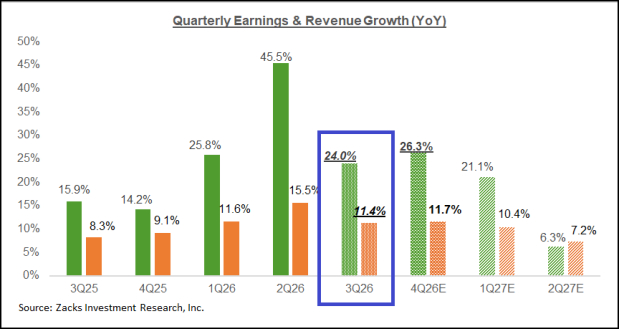
Image Source: Zacks Investment Research
As noted earlier, the revisions trend has been positive, sustaining the favorable trend in place for almost a year now. The chart below shows how 2026 Q3 earnings growth expectations have evolved lately.
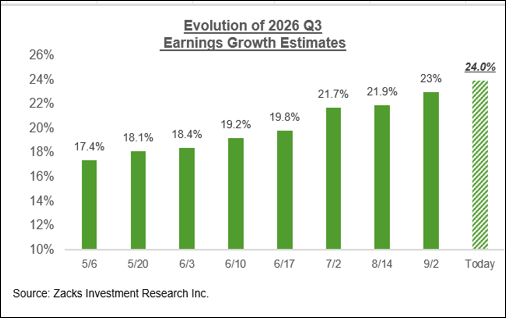
Image Source: Zacks Investment Research
This positive revisions behavior is not a new development; they extend a tailwind that has been building for nearly a year. Historically, these upward adjustments were tightly concentrated in Technology and, more recently, Energy following Middle East supply disruptions. However, for Q3 2026, the constructive estimate revisions have broadened significantly, rising across 8 of the 16 Zacks sectors—including Transportation, Finance, Aerospace, Industrials, Utilities, and Autos alongside Tech and Energy.
On the negative side, Q3 estimates have been under pressure for these 8 sectors since the quarter got underway – Conglomerates, Basic Materials, Consumer Staples, Consumer Discretionary, Medical, Business Services, Retail, and Construction.
Sector Focus: Broad-Based Strength
Q3 earnings are expected to be above the year-earlier level for 14 of the 16 Zacks sectors, with 5 sectors expected to enjoy double-digit growth. The Conglomerates sector is the only one expected to have lower earnings in Q3 relative to the same period last year (down – 35.4%), while earnings for the Consumer Staples sector are expected to be flat.
The 5 sectors expected to enjoy double-digit earnings growth in Q3 are Aerospace (up +159.3%), Energy (+111.9%), Tech (+41.9%), Basic Materials (+31.2%), and Transportation (+15.1%).
Q3 earnings growth for the S&P 500 index drops to +20% from +24% once the Energy sector’s contribution is excluded from the index. Excluding the Tech sector, Q3 earnings growth for the rest of the index drops to +14.4%.
The chart below shows the Q3 earnings and revenue growth expectations for the Tech sector relative to what we saw from the sector in the preceding two periods and what is expected in the following three quarters.
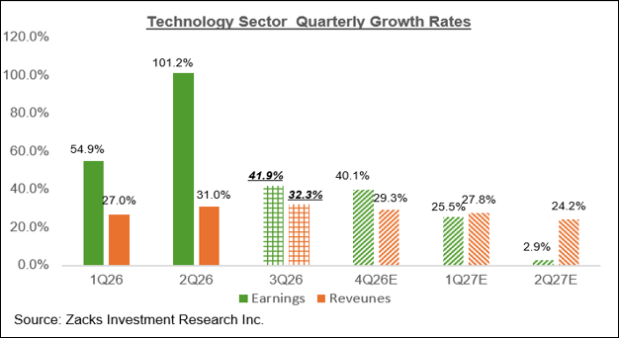
Image Source: Zacks Investment Research
Nvidia NVDA and Micron MU have been enjoying a record earnings run in recent quarters, and that performance continues in Q3 as well.
Nvidia’s Q3 earnings are expected to increase +90% year-over-year on +91.2% higher revenues, while the year-over-year earnings and revenue growth rates for Micron are expected to be +938% and +348.6%, respectively.
Q3 earnings growth for the Tech sector gets cut by slightly more than half once contributions from Nvidia and Micron are excluded, as the chart below shows.
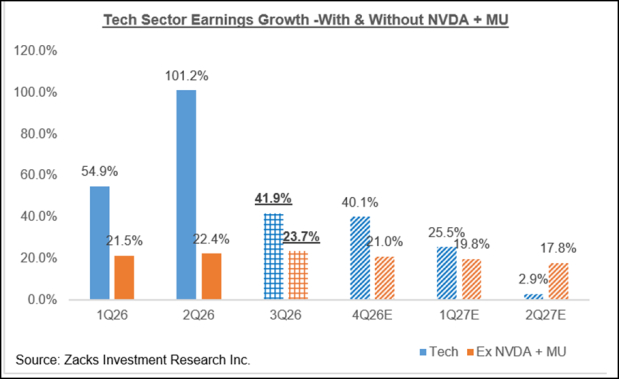
Image Source: Zacks Investment Research
Q3 Earnings Season Scorecard
The Q3 earnings season will get the spotlight when the big banks report on October 13th, but the reporting cycle actually got underway with the September 10th quarterly releases from Oracle and Adobe.
The Oracle and Adobe reports were for these Tech companies’ fiscal quarters ending in August, which get counted as part of the September-quarter tally. Homebuilder Lennar has since become the third S&P 500 member to report such Q3 results.
We have an additional six index members on deck to report their fiscal August-quarter results this week, including Costco, AutoZone, Darden and others.
Total Q3 earnings for the three S&P 500 members that have reported results already are up +22.6% from the same period last year on +14.9% higher revenues, with 33.3% beating EPS estimates and 66.7% besting revenue estimates.
The comparison charts below show the earnings and revenue growth rates for these companies compared to other recent periods.
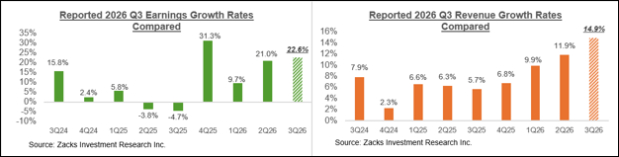
Image Source: Zacks Investment Research
The comparison charts below show the Q3 EPS and revenue beats percentages for these companies compared to other recent periods.
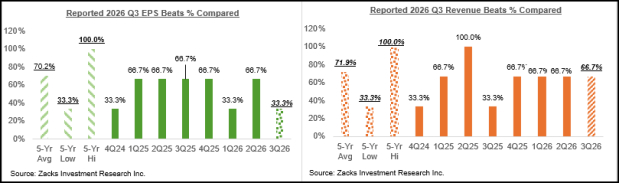
Image Source: Zacks Investment Research
The Earnings Big Picture
The chart below shows the aggregate growth picture for the S&P 500 index on a calendar year basis.
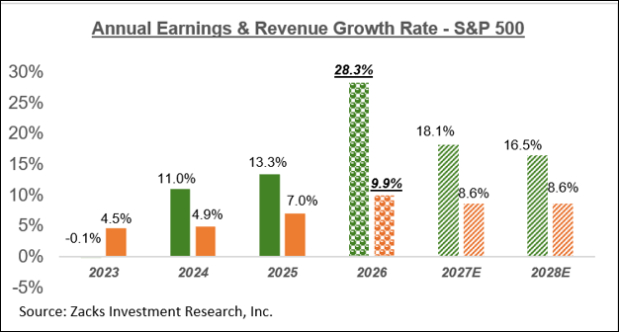
Image Source: Zacks Investment Research
For a detailed view of the evolving earnings picture, please check out our weekly Earnings Trends report here >>>> A Broad-Based Earnings Growth Picture As Revisions Stay Positive
Zacks' Research Chief Names "Stock Most Likely to Double"
Our team of experts has just released the 5 stocks with the greatest probability of gaining +100% or more in the coming months. Of those 5, Director of Research Sheraz Mian highlights the one stock set to climb highest.
Of course, all our elite picks aren't winners, but this one could far surpass earlier Zacks' Stocks Set to Double like D-Wave Quantum, which shot up +680.1%.
Free: See Our Top Stock And 4 Runners UpThis article originally published on Zacks Investment Research (zacks.com).
Innovative Industrial Properties (IIPR) Stock Sinks As Market Gains: Here's Why
In the latest close session, Innovative Industrial Properties (IIPR) was down 1.44% at $55.62. This change lagged the S&P 500's daily gain of 0.17%. Meanwhile, the Dow experienced a drop of 0.18%, and the technology-dominated Nasdaq saw an increase of 0.4%.
Shares of the company have depreciated by 0.53% over the course of the past month, outperforming the Finance sector's loss of 2.6%, and the S&P 500's loss of 1.29%.
Analysts and investors alike will be keeping a close eye on the performance of Innovative Industrial Properties in its upcoming earnings disclosure. In that report, analysts expect Innovative Industrial Properties to post earnings of $1.84 per share. This would mark year-over-year growth of 7.6%. Our most recent consensus estimate is calling for quarterly revenue of $66.07 million, up 2.15% from the year-ago period.
Regarding the entire year, the Zacks Consensus Estimates forecast earnings of $7.42 per share and revenue of $264.72 million, indicating changes of +2.49% and -0.47%, respectively, compared to the previous year.
Investors should also take note of any recent adjustments to analyst estimates for Innovative Industrial Properties. These revisions help to show the ever-changing nature of near-term business trends. As a result, upbeat changes in estimates indicate analysts' favorable outlook on the business health and profitability.
Our research suggests that these changes in estimates have a direct relationship with upcoming stock price performance. To exploit this, we've formed the Zacks Rank, a quantitative model that includes these estimate changes and presents a viable rating system.
The Zacks Rank system, stretching from #1 (Strong Buy) to #5 (Strong Sell), has a noteworthy track record of outperforming, validated by third-party audits, with stocks rated #1 producing an average annual return of +25% since the year 1988. Within the past 30 days, our consensus EPS projection has moved 1.47% lower. Right now, Innovative Industrial Properties possesses a Zacks Rank of #3 (Hold).
Looking at its valuation, Innovative Industrial Properties is holding a Forward P/E ratio of 7.61. This denotes a discount relative to the industry average Forward P/E of 12.01.
The REIT and Equity Trust - Other industry is part of the Finance sector. Currently, this industry holds a Zacks Industry Rank of 98, positioning it in the top 40% of all 250+ industries.
The Zacks Industry Rank evaluates the power of our distinct industry groups by determining the average Zacks Rank of the individual stocks forming the groups. Our research shows that the top 50% rated industries outperform the bottom half by a factor of 2 to 1.
Ensure to harness Zacks.com to stay updated with all these stock-shifting metrics, among others, in the next trading sessions.
Zacks' Research Chief Names "Stock Most Likely to Double"
Our team of experts has just released the 5 stocks with the greatest probability of gaining +100% or more in the coming months. Of those 5, Director of Research Sheraz Mian highlights the one stock set to climb highest.
Of course, all our elite picks aren't winners, but this one could far surpass earlier Zacks' Stocks Set to Double like D-Wave Quantum, which shot up +680.1%.
Free: See Our Top Stock And 4 Runners UpThis article originally published on Zacks Investment Research (zacks.com).
Zoetis (ZTS) Stock Drops Despite Market Gains: Important Facts to Note
In the latest close session, Zoetis (ZTS) was down 2.22% at $71.40. This change lagged the S&P 500's 0.17% gain on the day. Elsewhere, the Dow saw a downswing of 0.18%, while the tech-heavy Nasdaq appreciated by 0.4%.
The animal health company's shares have seen a decrease of 2.67% over the last month, not keeping up with the Medical sector's gain of 0.65% and the S&P 500's loss of 1.29%.
Investors will be eagerly watching for the performance of Zoetis in its upcoming earnings disclosure. The company's upcoming EPS is projected at $1.52, signifying a 10.59% drop compared to the same quarter of the previous year. In the meantime, our current consensus estimate forecasts the revenue to be $2.31 billion, indicating a 3.66% decline compared to the corresponding quarter of the prior year.
For the full year, the Zacks Consensus Estimates project earnings of $6.2 per share and a revenue of $9.24 billion, demonstrating changes of -3.28% and -2.45%, respectively, from the preceding year.
Investors should also pay attention to any latest changes in analyst estimates for Zoetis. These revisions typically reflect the latest short-term business trends, which can change frequently. Therefore, positive revisions in estimates convey analysts' confidence in the business performance and profit potential.
Our research shows that these estimate changes are directly correlated with near-term stock prices. To capitalize on this, we've crafted the Zacks Rank, a unique model that incorporates these estimate changes and offers a practical rating system.
The Zacks Rank system, stretching from #1 (Strong Buy) to #5 (Strong Sell), has a noteworthy track record of outperforming, validated by third-party audits, with stocks rated #1 producing an average annual return of +25% since the year 1988. Over the past month, the Zacks Consensus EPS estimate has shifted 0.09% upward. Zoetis is holding a Zacks Rank of #5 (Strong Sell) right now.
Digging into valuation, Zoetis currently has a Forward P/E ratio of 11.77. This signifies a discount in comparison to the average Forward P/E of 16.09 for its industry.
We can additionally observe that ZTS currently boasts a PEG ratio of 1.7. Comparable to the widely accepted P/E ratio, the PEG ratio also accounts for the company's projected earnings growth. By the end of yesterday's trading, the Medical - Drugs industry had an average PEG ratio of 1.78.
The Medical - Drugs industry is part of the Medical sector. At present, this industry carries a Zacks Industry Rank of 159, placing it within the bottom 36% of over 250 industries.
The Zacks Industry Rank is ordered from best to worst in terms of the average Zacks Rank of the individual companies within each of these sectors. Our research shows that the top 50% rated industries outperform the bottom half by a factor of 2 to 1.
You can find more information on all of these metrics, and much more, on Zacks.com.
Zacks' Research Chief Names "Stock Most Likely to Double"
Our team of experts has just released the 5 stocks with the greatest probability of gaining +100% or more in the coming months. Of those 5, Director of Research Sheraz Mian highlights the one stock set to climb highest.
Of course, all our elite picks aren't winners, but this one could far surpass earlier Zacks' Stocks Set to Double like D-Wave Quantum, which shot up +680.1%.
Free: See Our Top Stock And 4 Runners UpThis article originally published on Zacks Investment Research (zacks.com).
SolarEdge Technologies (SEDG) Stock Dips While Market Gains: Key Facts
In the latest trading session, SolarEdge Technologies (SEDG) closed at $34.67, marking a -3.69% move from the previous day. The stock trailed the S&P 500, which registered a daily gain of 0.17%. On the other hand, the Dow registered a loss of 0.18%, and the technology-centric Nasdaq increased by 0.4%.
The photovoltaic products maker's stock has climbed by 16.5% in the past month, exceeding the Oils-Energy sector's gain of 1.36% and the S&P 500's loss of 1.29%.
The upcoming earnings release of SolarEdge Technologies will be of great interest to investors. The company is predicted to post an EPS of $0.03, indicating a 109.68% growth compared to the equivalent quarter last year. Simultaneously, our latest consensus estimate expects the revenue to be $328.24 million, showing a 3.51% drop compared to the year-ago quarter.
Looking at the full year, the Zacks Consensus Estimates suggest analysts are expecting earnings of -$0.19 per share and revenue of $1.3 billion. These totals would mark changes of +92.02% and +9.57%, respectively, from last year.
Investors should also note any recent changes to analyst estimates for SolarEdge Technologies. These revisions help to show the ever-changing nature of near-term business trends. As such, positive estimate revisions reflect analyst optimism about the business and profitability.
Our research demonstrates that these adjustments in estimates directly associate with imminent stock price performance. To utilize this, we have created the Zacks Rank, a proprietary model that integrates these estimate changes and provides a functional rating system.
The Zacks Rank system, which ranges from #1 (Strong Buy) to #5 (Strong Sell), has an impressive outside-audited track record of outperformance, with #1 stocks generating an average annual return of +25% since 1988. Over the last 30 days, the Zacks Consensus EPS estimate has moved 2.04% higher. As of now, SolarEdge Technologies holds a Zacks Rank of #3 (Hold).
The Solar industry is part of the Oils-Energy sector. With its current Zacks Industry Rank of 236, this industry ranks in the bottom 5% of all industries, numbering over 250.
The Zacks Industry Rank assesses the strength of our separate industry groups by calculating the average Zacks Rank of the individual stocks contained within the groups. Our research shows that the top 50% rated industries outperform the bottom half by a factor of 2 to 1.
Keep in mind to rely on Zacks.com to watch all these stock-impacting metrics, and more, in the succeeding trading sessions.
Zacks' Research Chief Names "Stock Most Likely to Double"
Our team of experts has just released the 5 stocks with the greatest probability of gaining +100% or more in the coming months. Of those 5, Director of Research Sheraz Mian highlights the one stock set to climb highest.
Of course, all our elite picks aren't winners, but this one could far surpass earlier Zacks' Stocks Set to Double like D-Wave Quantum, which shot up +680.1%.
Free: See Our Top Stock And 4 Runners UpThis article originally published on Zacks Investment Research (zacks.com).
PagSeguro Digital Ltd. (PAGS) Stock Falls Amid Market Uptick: What Investors Need to Know
In the latest trading session, PagSeguro Digital Ltd. (PAGS) closed at $9.26, marking a -3.14% move from the previous day. This change lagged the S&P 500's daily gain of 0.17%. At the same time, the Dow lost 0.18%, and the tech-heavy Nasdaq gained 0.4%.
Shares of the company have appreciated by 13.27% over the course of the past month, outperforming the Business Services sector's loss of 3.68%, and the S&P 500's loss of 1.29%.
Analysts and investors alike will be keeping a close eye on the performance of PagSeguro Digital Ltd. in its upcoming earnings disclosure. The company is predicted to post an EPS of $0.41, indicating a 13.89% growth compared to the equivalent quarter last year. Meanwhile, the Zacks Consensus Estimate for revenue is projecting net sales of $996.93 million, up 6.38% from the year-ago period.
For the annual period, the Zacks Consensus Estimates anticipate earnings of $1.66 per share and a revenue of $4.02 billion, signifying shifts of +16.9% and +9.83%, respectively, from the last year.
Additionally, investors should keep an eye on any recent revisions to analyst forecasts for PagSeguro Digital Ltd. These revisions typically reflect the latest short-term business trends, which can change frequently. Consequently, upward revisions in estimates express analysts' positivity towards the business operations and its ability to generate profits.
Research indicates that these estimate revisions are directly correlated with near-term share price momentum. To utilize this, we have created the Zacks Rank, a proprietary model that integrates these estimate changes and provides a functional rating system.
The Zacks Rank system, running from #1 (Strong Buy) to #5 (Strong Sell), holds an admirable track record of superior performance, independently audited, with #1 stocks contributing an average annual return of +25% since 1988. The Zacks Consensus EPS estimate has moved 0.6% lower within the past month. PagSeguro Digital Ltd. presently features a Zacks Rank of #3 (Hold).
Valuation is also important, so investors should note that PagSeguro Digital Ltd. has a Forward P/E ratio of 5.77 right now. This represents a discount compared to its industry average Forward P/E of 12.76.
It is also worth noting that PAGS currently has a PEG ratio of 0.38. This popular metric is similar to the widely-known P/E ratio, with the difference being that the PEG ratio also takes into account the company's expected earnings growth rate. As of the close of trade yesterday, the Financial Transaction Services industry held an average PEG ratio of 0.88.
The Financial Transaction Services industry is part of the Business Services sector. With its current Zacks Industry Rank of 162, this industry ranks in the bottom 35% of all industries, numbering over 250.
The Zacks Industry Rank evaluates the power of our distinct industry groups by determining the average Zacks Rank of the individual stocks forming the groups. Our research shows that the top 50% rated industries outperform the bottom half by a factor of 2 to 1.
To follow PAGS in the coming trading sessions, be sure to utilize Zacks.com.
Zacks' Research Chief Names "Stock Most Likely to Double"
Our team of experts has just released the 5 stocks with the greatest probability of gaining +100% or more in the coming months. Of those 5, Director of Research Sheraz Mian highlights the one stock set to climb highest.
Of course, all our elite picks aren't winners, but this one could far surpass earlier Zacks' Stocks Set to Double like D-Wave Quantum, which shot up +680.1%.
Free: See Our Top Stock And 4 Runners UpThis article originally published on Zacks Investment Research (zacks.com).
Annaly Capital Management (NLY) Stock Sinks As Market Gains: Here's Why
In the latest trading session, Annaly Capital Management (NLY) closed at $21.05, marking a -1.22% move from the previous day. The stock's performance was behind the S&P 500's daily gain of 0.17%. At the same time, the Dow lost 0.18%, and the tech-heavy Nasdaq gained 0.4%.
The real estate investment trust's shares have seen a decrease of 8.5% over the last month, not keeping up with the Finance sector's loss of 2.6% and the S&P 500's loss of 1.29%.
Investors will be eagerly watching for the performance of Annaly Capital Management in its upcoming earnings disclosure. The company's upcoming EPS is projected at $0.78, signifying a 6.85% increase compared to the same quarter of the previous year. In the meantime, our current consensus estimate forecasts the revenue to be $545 million, indicating a 97.64% growth compared to the corresponding quarter of the prior year.
Looking at the full year, the Zacks Consensus Estimates suggest analysts are expecting earnings of $3.09 per share and revenue of $2.03 billion. These totals would mark changes of +5.82% and +78.78%, respectively, from last year.
Any recent changes to analyst estimates for Annaly Capital Management should also be noted by investors. Recent revisions tend to reflect the latest near-term business trends. As a result, we can interpret positive estimate revisions as a good sign for the business outlook.
Empirical research indicates that these revisions in estimates have a direct correlation with impending stock price performance. Investors can capitalize on this by using the Zacks Rank. This model considers these estimate changes and provides a simple, actionable rating system.
The Zacks Rank system, spanning from #1 (Strong Buy) to #5 (Strong Sell), boasts an impressive track record of outperformance, audited externally, with #1 ranked stocks yielding an average annual return of +25% since 1988. Over the past month, the Zacks Consensus EPS estimate has remained steady. Currently, Annaly Capital Management is carrying a Zacks Rank of #2 (Buy).
Digging into valuation, Annaly Capital Management currently has a Forward P/E ratio of 6.9. This valuation marks a discount compared to its industry average Forward P/E of 7.5.
We can also see that NLY currently has a PEG ratio of 1.68. The PEG ratio is similar to the widely-used P/E ratio, but this metric also takes the company's expected earnings growth rate into account. The REIT and Equity Trust industry currently had an average PEG ratio of 1.23 as of yesterday's close.
The REIT and Equity Trust industry is part of the Finance sector. Currently, this industry holds a Zacks Industry Rank of 216, positioning it in the bottom 13% of all 250+ industries.
The Zacks Industry Rank is ordered from best to worst in terms of the average Zacks Rank of the individual companies within each of these sectors. Our research shows that the top 50% rated industries outperform the bottom half by a factor of 2 to 1.
Remember to apply Zacks.com to follow these and more stock-moving metrics during the upcoming trading sessions.
Zacks' Research Chief Names "Stock Most Likely to Double"
Our team of experts has just released the 5 stocks with the greatest probability of gaining +100% or more in the coming months. Of those 5, Director of Research Sheraz Mian highlights the one stock set to climb highest.
Of course, all our elite picks aren't winners, but this one could far surpass earlier Zacks' Stocks Set to Double like D-Wave Quantum, which shot up +680.1%.
Free: See Our Top Stock And 4 Runners UpThis article originally published on Zacks Investment Research (zacks.com).
CONTACT US
100 West Lawrence Street
Suite 418
Appleton, WI 54911

HELPFUL LINKS
F.A.Q.
Privacy Policy
Terms of Use
Collar Capital Management, LLC is a registered investment adviser that offers advisory services to clients or prospective clients where Collar Capital Management, LLC and its representatives are properly licensed or exempted. This website is solely for informational purposes.